A "placebo controlled clinical study" demonstrates that the power of belief is removed from a pharmaceutical drug test. The mind can actually dissolve a cancer tumor if that patient merely believes the swallowed pill has a drug in it, even if there is nothing in the pill.—The Holographic Universe >>
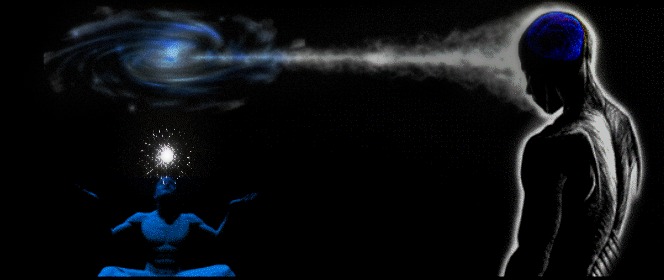
According to the most well-tested theory in physics, Quantum Mechanics, your consciousness changes reality. In this theory, the phenomenon known as the collapse of the Quantum Wave Function is what brings reality into existence. This is a fancy way of saying that one's conscious observation of small unseen waves actually causes those waves to "collapse" into matter. In other words, conscious observation materializes particles into existence. We create our reality through our Focus and Intention.
We are all here perceiving through our "meat puppet" body, and interpreting everything through your receptors and making value judgments based on our life's experiences. Some elements you gloss over or ignore (even if they are important to others, but they aren't your focus, so they don't matter.)
Others you focus very strongly upon. You don't even fully acknowledge just how much you focus on them, but the intensity is so palpable that its like you are digging a groove into the fabric of reality, and you are making sure that each step in your path moves you closer and closer to your desired outcome. Sometimes things do happen in a way that seems like a miracle or magic, such as spontaneous remission from cancer, or whatever else you might feel qualifies, but mostly we just create through intention (focus) transforming energy into matter (in our minds).—What the Bleep, Do We Know?! >>
Everyone does it all the time, even when you are blind, deaf, colorblind, in a sensory deprivation chamber, on drugs, drowning, etc. When we mentally focus, energy becomes matter. Everything else is just background or white noise, the "Hum of the Universe", potential. Then it becomes real (to us) because we call it forth in our mind. Science has already demonstrated how we use our body's various receptors, skin, eyes, ears, to register input which are in the form of energy waves (light, sound, etc.) which processes to our brains and is interpreted. —The Biology of Belief >>
All reality happens in our minds. Always has, always will. If your "meat puppet" body, which is not you, malfunctions, things can cut off certain receptors, and thus reality changes for you to accommodate your new perception status. If you die, meaning your "meat puppet" body becomes severed from your use in perceiving this Reality anymore, then you move on into the higher realms and your journey here is over and this Reality ceases to be of primary focus. —The Divine Matrix >>
So many accept what is taught when without using reason or logic. Evolution does not teach that "we descended from monkeys", it teaches that Humans, like other Primates [including Monkeys and Apes], descended from a common ancestor. And down through time, the evolutionary chain continued. And then we arrive at a species that does not seem to fit as well as the rest. Homosapian's gestation period of 9 months mimics the 3.8 billion years evolution of all life on Earth. The human embryo repeats the evolution of all species. When the sperm and egg unite, this new creation, is a single-celled organism. Within hours, this single cell divides and multiplies more rapidly than any other species. 4 weeks later, the embryo begins to develop gills mimicking aquatic life. A few weeks later it develops lungs and a tail with reptilian appearance. From there, a mammal is recognizable, and then on to a primate form. It then sheds its lacuna which is the embryonic fur. And at last, shows the characteristics of a human child. —Creation >>
Ethics and morality are secular constructs, arrogated by religion.
A particular action or choice is morally RIGHT when it somehow promotes happiness, well-being or health, or it somehow minimizes unnecessary harm or suffering or both. A particular action or choice is morally WRONG when it diminishes happiness, well-being or health, or it somehow causes unnecessary harm or suffering or does both.
The 'Ethic of Reciprocity' or the Golden Rule predates Christianity by at least several thousand years, was never exclusive to Judaism, and is a fundamental moral value which simply means 'treat others as you would like to be treated.' It is arguably the most essential basis for the modern concept of human rights, though it is not without its critics. The Golden Rule was a common principle in ancient Greek philosophy as demonstrated by the writings of Pittacus, Thales, Sextus, Isocrates and Epictetus. It is also a basic tenant of Buddhists, Confusianists, Hindus, Taoists, etc.. —The Golden Rule >>
Truly trust that Creation is unfolding continuously, and that all we really need to do is "allow." I sometimes forget this very important message that Abraham teaches:
We are always struggling when we resist the flow and try paddling UP-stream. But once we stop rowing and allow the oars to rest, the canoe we are riding in will turn and flow naturally to our abundance.
The energy of the Source is molding the Universe correctly, and we have come to this point in time, all together. The man-made and the Creation formed are merging and becoming one. People get upset about the New World Order (NWO), yet they don't recognize that this is pure nature at its best. This is us -evolving to an recognition that the whole planet's population is not of separate tribes, nations or even continents, but really one world.—Novus Ordo Seclurum >>
I'm on a Spiritual Path unencumbered by dogma or ritual, and it is my wish for everyone to see beyond religion and intuit naturally our interconnetedness and ability to recognize our common energetic creative and eternal essence. No Heaven, No Hell, no separation.
I separate the concepts of spirituality from religion.
Religion is a form of mass mind-control, typically forged out of superstitious fear and mandates that the "believer" abandons their own ability to think rationally to blindly adhere to the dogmas of their faith, even when those dogmas seem to contradict what they sense is fundamentally true and false.
Rather, as a spiritual person, I feel we are free-flowing entities, who can tap into our spiritual nature by allowing our Imagination to open and expand our perception beyond the physical senses.
Our social and religious structures have ingrained within us that is it wrong to be playful and imaginative. Even though everything that we use to define ourselves and our societies actually sprang from our imagination: language, inventions, tools, art, music, everything.
The very fact that we are able to communicate via a computer is the result of someone tapping into imagination, and then we create shared imagery through our communication which occurs solely in our minds through imagination.
Our natural state is one of creativity, bliss and unconditional love and acceptance. —Religion vs Spirituality >>
Christians have this concept of being "Created in the Image of God" all backwards. Yes, we are created in the image of the Creator, but that Creator is us. We are Created to be creators.
You see, we are the creators of our own lives, as much as we are the destroyers of the same. The "image" of god is our imagination which is the pure source energy of our ability to create. All things spring from our imagination. That is why god is imaginary.
Imagination is creation.
Sadly Christians have imagined god in their image, thus anthropomorphizing god into a petty, vindictive male figure replete with all the baser instincts stemming from superstition (resulting from a lack of knowledge).
The Bible is a book of fairytales used to manipulate and coerce people into alignment with a form of dictatorship which inhibits free imagination, hence stymies evolution and expansion, which is the antithesis of our true nature.
Your imagination is a wonderful and creative tool.
Imagine that there was indeed a spiritual aspect to living; it would be through our imagination that you would be able to gain access to it.
It is true that imagination, if wielded destructively, can cause great harm (war, weapons, hate-speech, and even religions are proof enough of that), but if wielded creatively it can achieve fantastic heights. —You Are Your Savior >>
I am not an Atheist, and most definitely not religious.
I do NOT believe in some anthropomorphic god-entity, but rather that EVERYTHING that is, and even that which we do not yet comprehend or are not yet aware of, is "god." That means you and I, and everyone else is also god... not "gods", but rather just one single total god. That we are ALL connected and entangled at a quantum level, and through this we are able to exchange information, even when we are not completely conscious of it.
The way I view everything is as a Fractal. That everything at a macrocosmic level is mirrored at the microcosmic level too. We are typically only aware of our position within the fractal and the higher and lower positions are typically beyond our physical perception, but technology, like telescopes and microscopes are slowly demonstrating these greater and smaller worlds and we are acclimating to these new ways of "seeing."—Spiritual Freedom >>
Today, many people become entangled in the external turmoil of the world as some humans become maimed and murdered in the name of God by religious and political fanatics with tunnel vision who have no knowledge of ‘The All’ or ‘The Spirits’ true reality. They do not seek to contribute and assist humanity in their Spiritual advancement except to destroy. Like the carnivorous beasts in nature; territorial and they lay cunningly in wait for their next victim. The beasts in nature are not blamed for following their cravings so prompted by the Laws of Nature.
But man in whom intellect has unfolded is capable of descending below the animal plane and becomes satanic in nature having sunk very low in the scale of Life while embracing the lower parts of Mental Polarity in Human Nature. These types of humans are found not only in the arena of religious and political fanaticism but in all levels of society including world commerce in the greed, theft, dishonesty, fraud, and underhandedness, of certain corporate entities of which none is a contributor to the advancement of humanity but to bring suffering and destruction to humans.— An Old Axiom >>
I have a certain way in which I live, and certain rules in which I live my life. I tend to gravitate to Anyone with an open mind about the nature of reality and its spiritual aspects, but can use a fair measure of rational thinking when coming to their personal understanding of the nature of science and spirituality. Especially those who can tell the difference between spirituality & reason and that of "fear" & "faith" (coercion through religious dogma and blind submission to authority and mythology). —Rules I Live By >>
The information presented here is to empower you and enhance your beliefs by finding out the deep driving meanings behind them.
These are all ways to explain the same behavior process that begins with awareness, begins with consciousness. And if you get rid of all the images and concepts in our minds, of these sayings in your head, and just try to feel the difference between the two polarities, you'll begin to notice that all of the different scenarios and possibilities that are playing out in the world, all spawn from this common origin.—My Personal Message >>
Today I overheard a young woman telling a co-worker that she sometimes wakes up crying, she doesn’t know why, but she can’t help it. She recently immigrated here and she has a husband and two kids and she didn’t understand how such a seemingly perfect life that she could still spend mornings crying in the shower, before pulling herself together to send her kids off to school and heading off to work.
It wasn’t my conversation to join, but I wanted to tell her that I understand, that her pain is justified, but that she has a choice, just as we all do, just as Bill Hicks said. “between fear and love" —Fear & Love >>
For the first time in the history of the world has mankind been able to document it's own evolution.
Perhaps most astounding is the time frame from 1900 to 2000 which has brought about events shaping us into the species we are today. We are a direct product of our environment. We are what we eat so to speak.
Like babies growing up, we have learned how to crawl, and we have learned to stand on our feet and walk. Technology too, has taken a steps affording us the opportunity of traveling anywhere in the world and also, the ability to communicate instantly. Knowledge and information have never before been so readily available. —Awakening Is Now >>
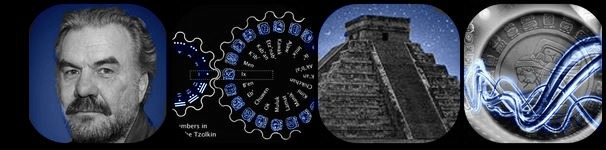
The Maya Sacred Tzolkin Calendar (the "True count" as used by the Maya for 5000 years). Mayan Sun signs (called Sacred "Day" Signs in their Astrology) consist of 20 signs total, and based on your Date of Birth, there is also a corresponding Energy Number/Galactic Tone (1 thru 13) representing your relationship to the Galaxy!
The Mayan sacred calendar is much more than just a calendar. Thinking of the Tzolkin as only a calendar would be like thinking of your computer as only a clock. The Tzolkin is a record of the flow and combination of the solar and galactic light which creates a light frequency for each day. This frequency in turn creates the "stage" on which we act out our lives. Once a person has determined or remembered his part in the play of life, (his or her frequency), they can more easily harmonize with reality to accomplish their goals.
We human beings consider ourselves to be made up of "solid matter." Actually, our physical body is the end product so to speak, of subtle information fields, which mold our physical body as well as all physical matter. These fields are "holograms" which change in time and are outside the reach of our normal senses. This is what clairvoyants perceive as colorful egg shaped "halos" or "auras" surrounding our physical body etheric body. The etheric body is a "holographic energy template" which guides the growth and development of our physical body. We create our bodies as we create the experience of our world.—Arising To Zero Point Energy >>
The most advanced Masters may acquire the powers usually attributed to the gods of men; and there are countless ranks of being, in the great hierarchy of life, whose being and power transcends even that of the highest Masters among men to a degree unthinkable by mortals.
So that even these highest Beings, whose power exceed even those attributed by men to their gods --if even these are bound by and are subservient to Law, then imagine the presumption of mortal man, of our race and grade, when he dares to consider the Laws of Nature as "unreal," visionary and illusory, because he happens to be able to grasp the truth that the Laws are mental in nature, and simply imaginary creations of 'the all.'
So long as the Universe endures, will they endure --for the Universe exists by virtue of these Laws which form its framework and which hold it together.
These laws govern how your life evolves, regardless of whether you believe in them or not. —The Seven Universal Laws >>